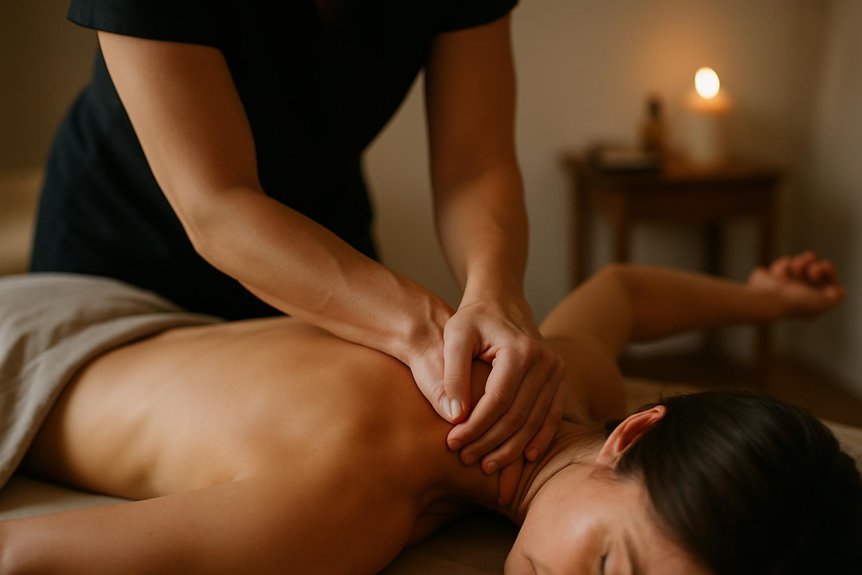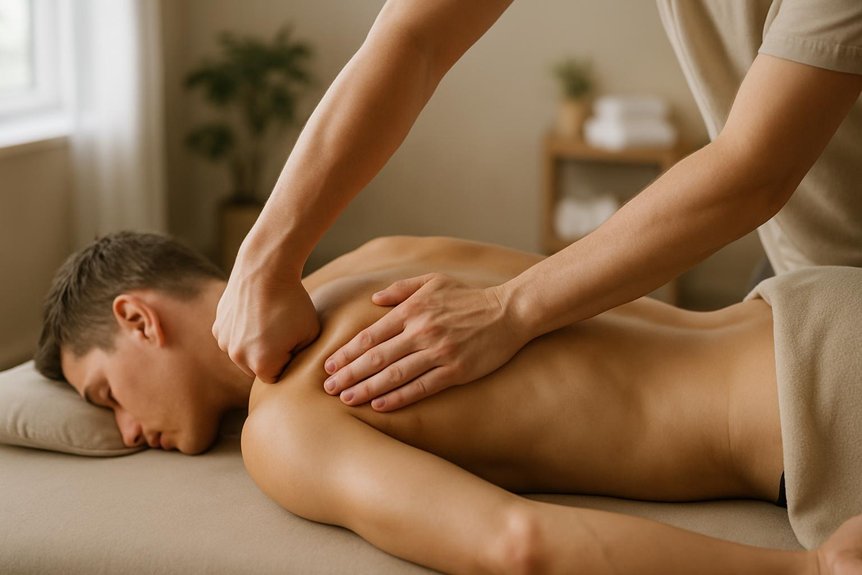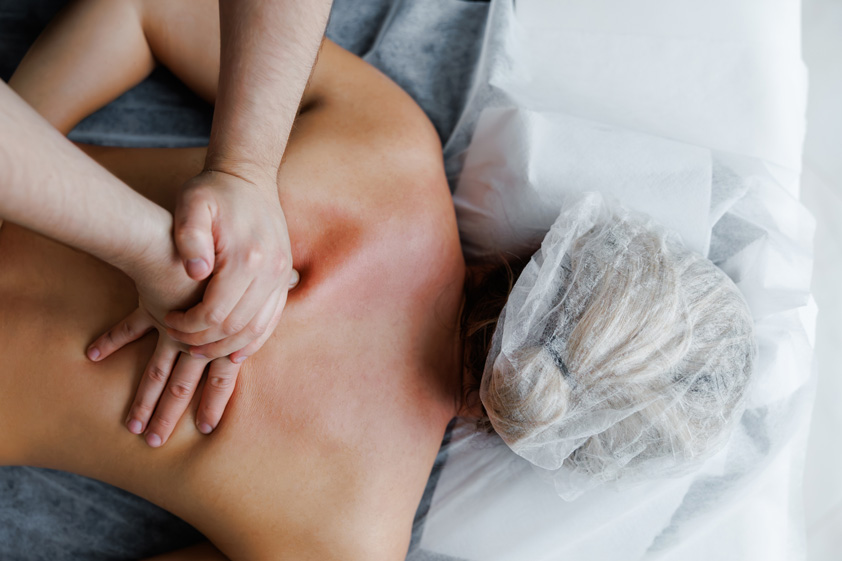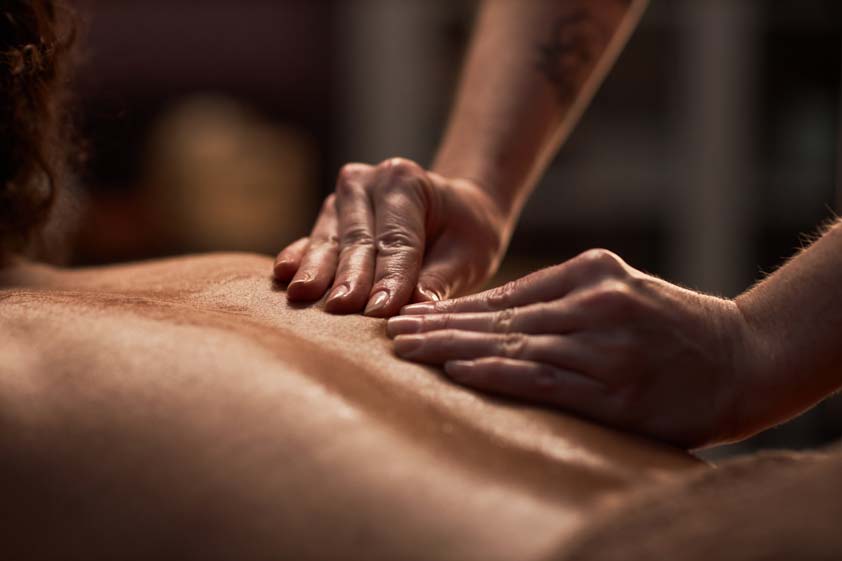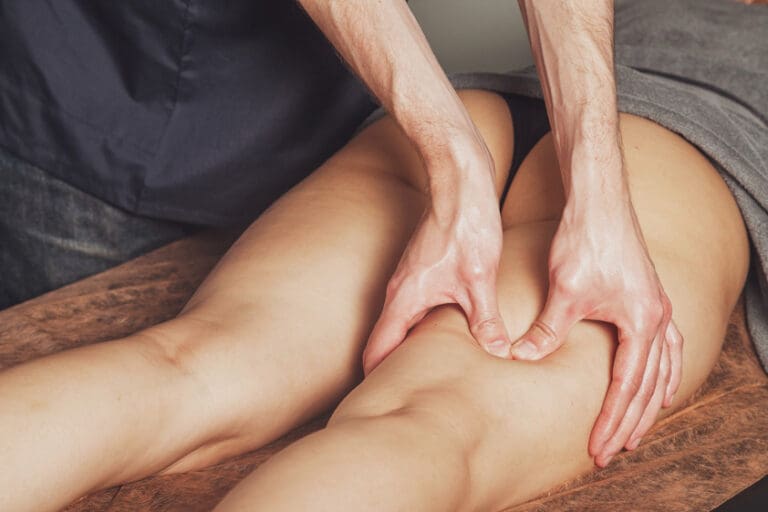
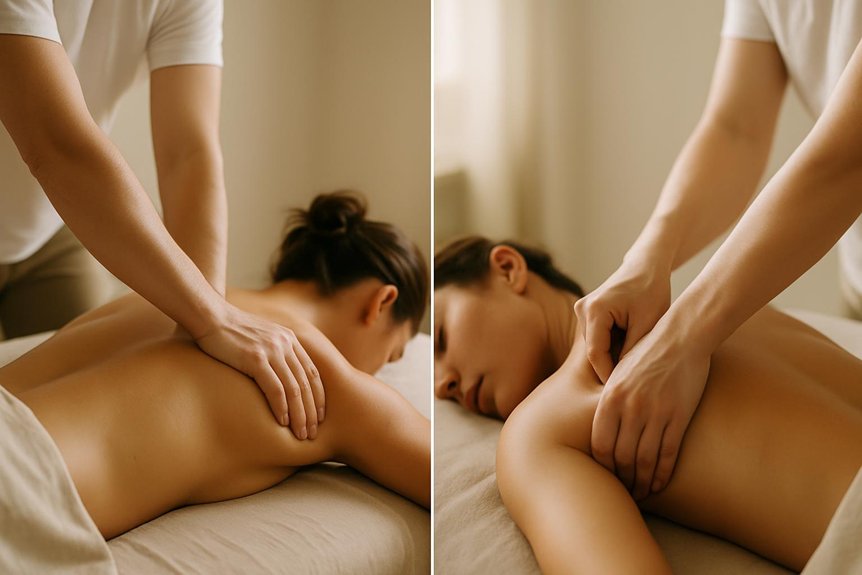
It is used to reduce broad muscle and fascial stiffness across larger areas such as the back, shoulders, and legs, using slow, sustained firm strokes. Trigger point therapy targets specific hypersensitive knots (taut bands) with precise compression to deactivate points that reproduce familiar local or referred pain. Trigger point relief may occur within minutes to 48 hours, while deep tissue changes often evolve over 24–72 hours and build over 3–6 sessions. Further details clarify selection and pacing.
Deep Tissue vs Trigger Point: How to Choose
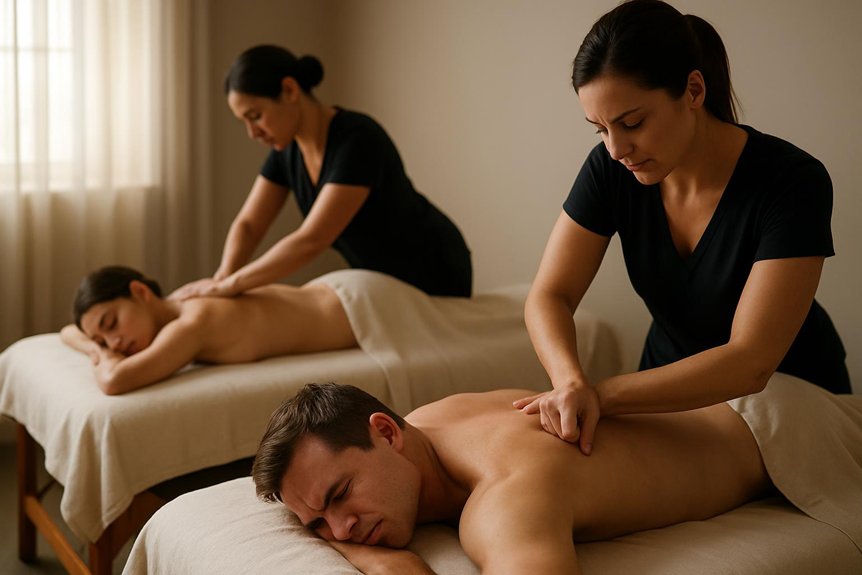
In clinical terms, choosing between intensive tissue massage and trigger point therapy depends on whether the primary goal is broad, sustained relief of muscle tension or targeted deactivation of localised pain “knots.”
Deep tissue work is generally selected when stiffness and restricted movement are widespread—such as across the back, shoulders, or legs—whereas trigger point therapy is typically preferred when symptoms trace to specific, hypersensitive spots that reproduce familiar pain patterns, including referred pain.
Deep tissue techniques commonly use slow strokes with firm pressure to work through deeper muscle layers and long-held tension.
At Spa & Massage, selection is guided by history, palpation findings, and comfort with pressure, ensuring a close, respectful therapeutic experience.
Clients describing diffuse ache after desk work often benefit from deeper, slower pressure, while pinpoint pain with radiating sensations tends to respond to focused holds.
Contraindications, bruising risk, and recovery time are reviewed, and aftercare is personalised.
What Deep Tissue Massage Targets and Feels Like
It is typically chosen when tension and restriction are widespread rather than confined to a few discrete trigger points, so the work aims at the larger muscle groups and connective tissues that limit movement and sustain pain.
It targets deeper layers of fascia and muscle in areas such as the back, hips, glutes, hamstrings, calves, shoulders, and neck, supporting mobility and postural ease.
In Spa & Massage clinics, therapists use slow, sustained pressure and specific strokes, adjusting depth to the client’s breath and tolerance.
Sensation is often intense yet controlled: a “good pain” that stays within comfort and softens as tissue yields.
Afterwards, clients may feel looser, warmer, and mildly tender, with improved range of motion.
Hydration and gentle movement are recommended post-session.
Trigger Point Therapy for Knots and Referred Pain
Trigger point therapy focuses on discrete hyperirritable spots within taut muscle bands—often felt as “knots”—that can restrict movement and provoke local tenderness.
These points may also produce referred pain, meaning symptoms can be perceived away from the source (for example, shoulder trigger points contributing to headaches or arm discomfort).
In Spa & Massage clinics across London, therapists assess palpation findings alongside reported pain patterns to guide targeted pressure and release strategies tailored to the client’s presentation.
Knots And Trigger Points
For many clients, “knots” are best understood as hyperirritable spots within a taut band of muscle (myofascial trigger points) that can reproduce familiar symptoms when compressed. They may feel like tender nodules, and can limit range of motion, disrupt sleep, and heighten stress sensitivity.
In Spa & Massage clinics across London, therapists assess the tissue’s texture and the client’s moment-to-moment feedback, then use sustained, tolerable pressure, slow releases, and gentle stretching to reduce local tenderness and restore glide between muscle and fascia.
Sessions are paced to feel safe and contained, with clear consent and breath cues to support comfort. Aftercare typically includes hydration, heat, and low-load movement to maintain softness without provoking soreness.
Referred Pain Patterns
Why does a sore spot in the neck sometimes present as a headache or arm ache? Trigger points can create referred pain: the brain interprets irritation in one muscle as discomfort elsewhere along predictable maps. For example, upper trapezius points may refer to the temple, while scalene points may mimic forearm or hand symptoms.
Evidence suggests that palpation reproduces familiar pain and that sustained, precise pressure can reduce sensitivity and restore normal movement. At Spa & Massage clinics across London, therapists assess posture, range of motion, and symptom patterns to distinguish referred pain from nerve compression or joint injury.
Treatment often combines trigger point release with slow deep tissue strokes, paced breathing, and aftercare: heat, hydration, and gentle stretching to support calm, connected recovery.
Pain, Pressure, and Results: Deep Tissue vs Trigger Point
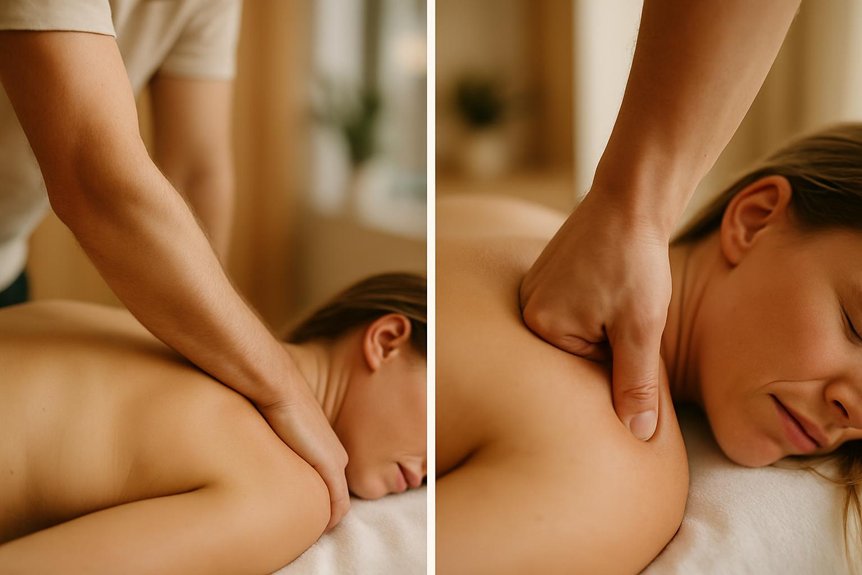
Pain and pressure can differ markedly between intensive tissue massage and trigger point therapy, with client comfort guided by a “strong but tolerable” threshold to minimise protective muscle guarding.
Deep tissue work typically applies sustained, broader pressure across muscle layers, while trigger point techniques use more localised compression that may feel sharper and can reproduce referred sensations.
Results and recovery timelines also vary, with some clients noticing immediate change and others experiencing short-lived post-treatment soreness, so Spa & Massage therapists in London tailor intensity and aftercare to support safe, measurable improvement.
Pain And Pressure Levels
Often, the key difference clients notice between intensive tissue massage and trigger point therapy is how pressure is applied and how discomfort relates to results. Deep tissue typically uses sustained, broad pressure and slow strokes across muscle layers; intensity can build gradually and feel like “good pain” when kept within a tolerable, breathing-friendly range.
Trigger point therapy applies focused compression to specific taut bands; discomfort is often sharper, more localised, and may refer sensation elsewhere, yet should remain controlled and consensual.
At Spa & Massage clinics across London, therapists monitor facial tension, breath, and verbal feedback, adjusting depth, speed, and angle to protect nerves and sensitive tissues.
Clear communication and continuous consent help preserve relaxation and a sense of safe intimacy throughout.
Results And Recovery Timeline
How quickly can clients expect change after treatment? Trigger point therapy often gives rapid relief in referred pain within minutes to 48 hours, as taut bands soften and local tenderness reduces.
It tends to shift stiffness and restricted range over 24–72 hours, with cumulative gains across 3–6 sessions.
Mild post-treatment soreness is common for both and typically settles within 24–48 hours; hydration, gentle movement, and heat can support comfort.
In Spa & Massage clinics, therapists pace pressure with breath cues and consent, aiming for “productive discomfort,” not guarding.
Clients should avoid intense training for 12–24 hours when sore.
If pain spikes, bruising appears, or numbness persists, reassessment is advised.
Best Uses: Intensive Tissue Massage vs Trigger Point Therapy
In clinical practice, intensive tissue massage is best used for broad, persistent muscular tightness and postural strain patterns that span multiple muscle groups, whereas trigger point therapy is best suited to pinpoint, reproducible “knots” that refer discomfort to other areas (e.g., neck tension contributing to headaches).
Deep tissue work is often indicated when the aim is to soften dense fascial restriction, improve tissue glide, and support comfort with sitting, commuting, or training. Trigger point approaches are commonly chosen when a client can identify a specific tender nodule that reliably recreates symptoms, such as shoulder referral into the arm or gluteal points mimicking sciatica-like pain.
At Spa & Massage, therapists typically combine both methods when assessment suggests global tension plus distinct trigger points, balancing intensity with safety and consent.
What Happens in Your London Session at Spa & Massage
From arrival to aftercare, a London session at Spa & Massage follows a structured clinical flow designed to match technique selection (deep tissue, trigger point, or a blend) to the client’s presentation and comfort.
A brief intake reviews pain patterns, training load, stress, sleep, and consent, then therapist-led palpation locates tissue tone, referral points, and sensitivity.
Pressure is negotiated using a clear scale, prioritising slow, warm contact and steady breath to support relaxation and safety.
Deep tissue work targets broader fascial restriction; trigger point therapy applies precise compression and release, with pauses for sensation to soften.
In Spa & Massage clinics, therapists use professional oils and draping for warmth and privacy.
Aftercare includes hydration, gentle movement, and guidance on soreness, heat/ice, and follow-up.
Conclusion
Intensive tissue massage and trigger point therapy address muscular pain through different mechanisms: broad fascial and muscle restriction versus discrete hyperirritable loci with referred patterns. Selection should follow symptom mapping, palpatory findings, and tolerance for sustained pressure. Deep tissue commonly supports global mobility and postural strain, while trigger point work can rapidly downregulate focal knots. As if consulting a pocket pager in a modern clinic, Spa & Massage therapists in London tailor dosage, pacing, and aftercare to optimise outcomes and minimise flare-ups.