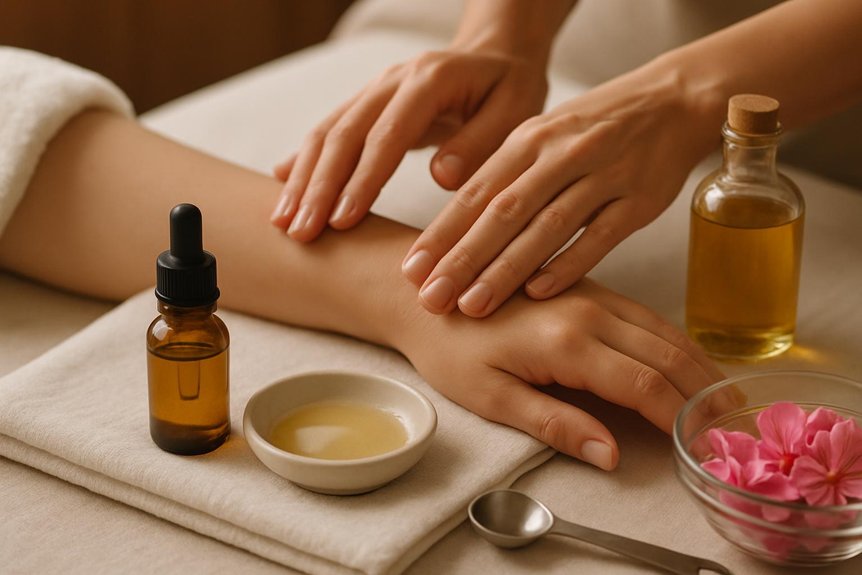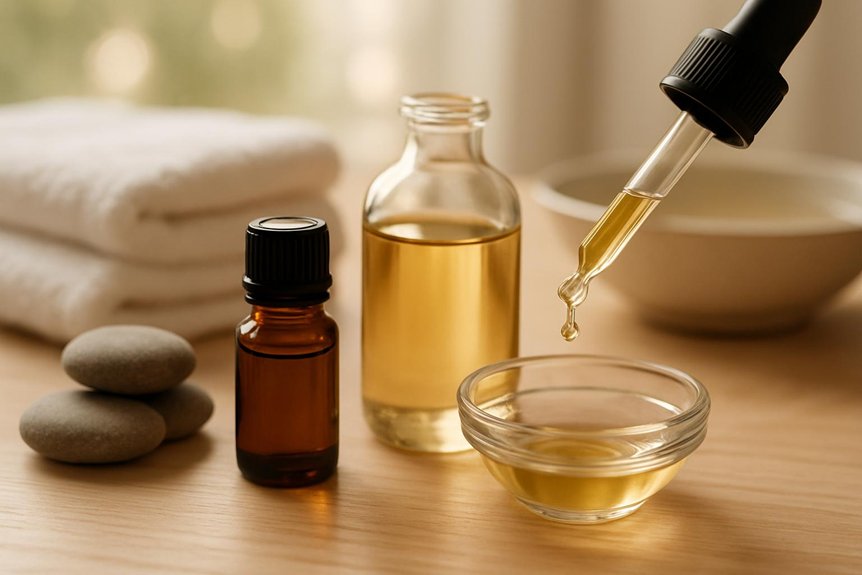
For aromatic massage, frankincense essential oil is typically diluted to 0.5–2% in a measured carrier oil to reduce irritation risk. Using ~20 drops per 1 mL, this equals about 1 drop per 10 mL (0.5%), 2 drops per 10 mL (1%), or 4 drops per 10 mL (2%). Measure the carrier first, add counted drops, cap and roll to mix, and label the date. Patch test for 24 hours and use lower dilutions for sensitive skin or pregnancy; more guidance follows.
Frankincense Oil Dilution Ratios for Massage (0.5–3%)
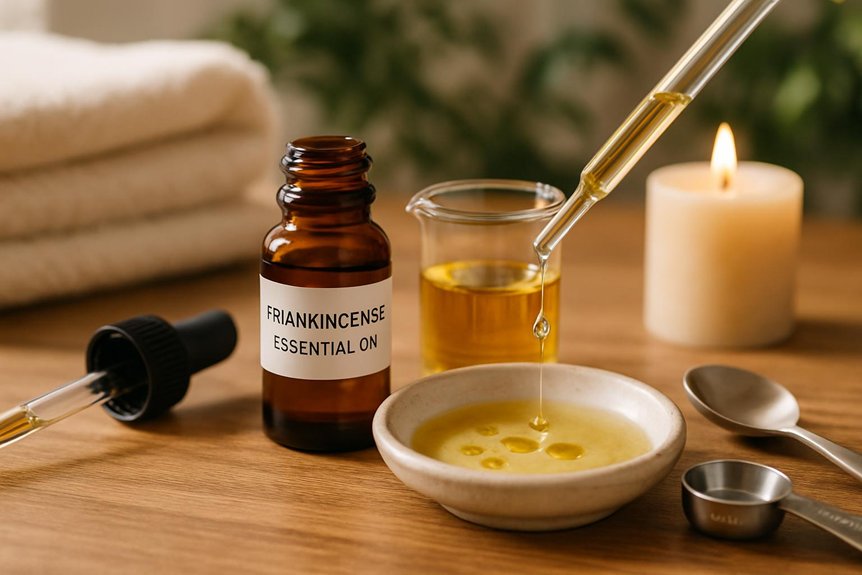
A 0.5–1% blend suits facially sensitive areas, first-time clients, or relaxation-focused sessions where closeness and comfort matter.
1–2% is commonly used for full-body aromatic massage to support calm breathing and a warm, grounding atmosphere.
2–3% is reserved for short, targeted work on robust skin, never near eyes or mucosa.
To relax and heal, these ratios pair well with aromatherapy massage techniques that emphasize slow strokes and steady breathing.
Patch testing, avoiding broken skin, and stopping with irritation are standard precautions. Pregnancy and medical conditions require clinician-led guidance.
Drops to mL: An Easy Frankincense Dilution Chart
For accurate, skin-safe aromatic massage, Spa & Massage therapists calculate frankincense dilution by converting drops to mL (noting that drop size varies by dispenser, so measuring by volume is more reliable).
The chart that follows provides a quick percent-dilution guide alongside practical drop-to-mL conversions to support consistent mixing.
It also lists common carrier-oil bottle sizes (e.g., 10 mL, 30 mL, 50 mL, 100 mL) with corresponding drop counts to help clients and therapists standardise blends.
Drop-To-mL Conversions
Two practical factors determine how many drops equal 1 mL—dropper tip size and oil viscosity—so any drops-to-mL chart should be treated as an estimate rather than a lab measurement.
In practice, many aromatherapy references use 20 drops ≈ 1 mL for essential oils dispensed from a standard orifice reducer. For frankincense, a workable range is 18–25 drops per 1 mL, depending on temperature and dispenser.
For safer, more intimate massage blending, Spa & Massage therapists suggest measuring carrier oil in mL, then adding essential oil by drops while keeping notes for consistency.
If a blend feels too strong on the skin, it should be immediately diluted with more carrier oil, not “balanced” with extra essential oil. Patch testing remains advisable before full-body use.
Dilution Percent Quick Guide
Often, the simplest way to dilute frankincense for aromatic massage is to choose a target percentage and translate it into drops per measured mL of carrier oil using a consistent drops≈mL estimate.
Using ~20 drops per mL, a practical quick guide is: 0.5% = 1 drop per 10 mL; 1% = 2 drops per 10 mL; 2% = 4 drops per 10 mL; 3% = 6 drops per 10 mL.
For intimate, close-to-skin massage, Spa & Massage therapists generally keep facial, neck, and décolletage blends at 0.5–1%, and body blends at 1–2%, adjusting lower for sensitive skin.
A patch test and avoiding mucous membranes reduce irritation risk. Pregnant clients should seek clinician-led guidance.
Common Bottle Size Chart
At a glance, a common bottle size chart makes it easier to dilute frankincense essential oil accurately by matching typical carrier-oil volumes (such as 10 mL, 30 mL, or 50 mL) to a precise number of drops for a chosen dilution percentage.
Using the standard assumption of ~20 drops per 1 mL, 1% equals 2 drops per 10 mL, 6 drops per 30 mL, and 10 drops per 50 mL.
For 2%, use 4, 12, and 20 drops; for 0.5%, use 1, 3, and 5 drops.
Spa & Massage therapists recommend starting lower for facial, décolletage, or sensitive skin, patch testing, and avoiding broken skin.
For intimate, close-contact massage, slow warming strokes help distribute oil evenly and reduce irritation.
Choose a Carrier Oil for Frankincense Massage Oil
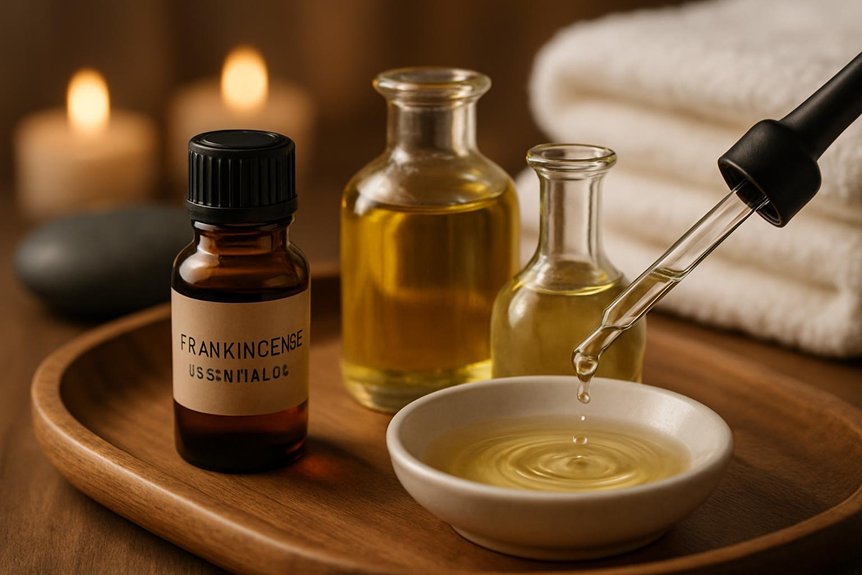
Carrier-oil selection is the safety step that determines how well frankincense essential oil disperses on the skin and how smoothly it glides during massage.
At Spa & Massage clinics, therapists prioritise cold-pressed, fragrance-free oils with clear ingredient lists to reduce irritation and keep the aroma clean and sensual.
For most bodies, jojoba or fractionated coconut offers a silky, non-greasy slip and long working time; sweet almond provides richer glide but is avoided with nut allergy.
Grapeseed suits those wanting a lighter finish, while apricot kernel can feel softly nourishing for dry skin.
For sensitive or intimate areas, a simple, low-allergen option is preferred, and patch testing is advised.
Oils should be fresh, stored cool and dark, and discarded if rancid.
Dilute Frankincense Oil Step by Step (Bottle or Bowl)
Before any aromatic massage begins, frankincense essential oil should be measured and diluted into a suitable carrier at a skin-safe concentration, either directly in a clean, dark glass bottle for storage or in a small bowl for immediate use.
For adults, Spa & Massage therapists typically keep frankincense at 1–2% (about 1–2 drops per 5 ml carrier).
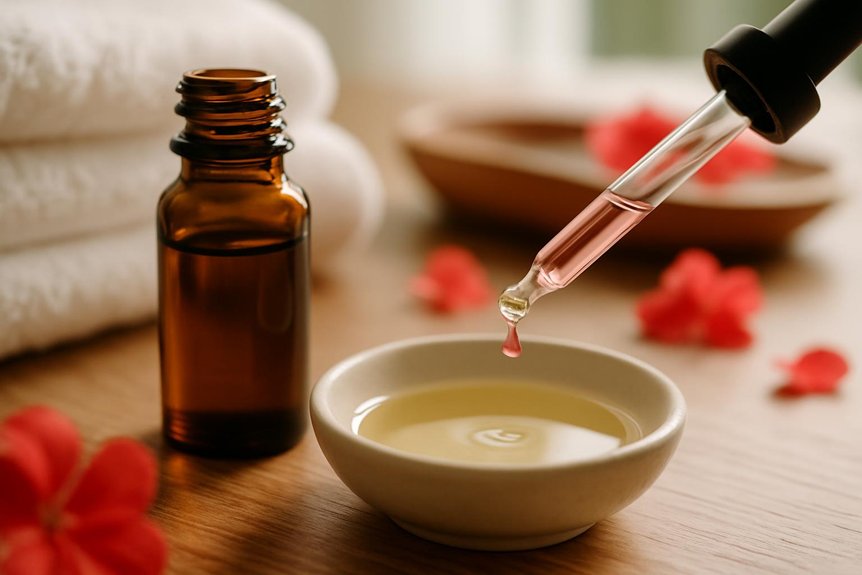
In a bottle: pour in the carrier, add the counted drops, cap, and roll gently between palms to blend; label with date and dilution, then store cool and away from light.
In a bowl: measure the carrier, add drops, and stir with a clean spoon for immediate application.
Use sparingly, warming the oil in hands before slow, close-contact strokes.
Patch Test Your Frankincense Dilution (24 Hours)
Why patch test a frankincense dilution? Even well-diluted essential oils can trigger irritation or allergic contact dermatitis, especially when used during close, skin-to-skin aromatic massage. A simple 24-hour check helps protect comfort, trust, and the relaxed closeness many clients seek.
To patch test, apply a pea-sized amount of the diluted blend to clean, dry skin on the inner forearm. Cover with a small plaster and keep the area dry. Leave for 24 hours, removing sooner if burning, stinging, or itching begins.
After removal, look for redness, swelling, rash, or warmth. If any reaction appears, discontinue and wash with mild soap and plenty of water. At Spa & Massage, therapists only proceed when skin remains calm and clear.
When to Use a Lower Frankincense Dilution (Sensitive Skin, Pregnancy)
Although frankincense essential oil is generally well tolerated when properly diluted, a lower dilution is the safer default for anyone with reactive or easily irritated skin and for pregnancy, where hormonal and circulatory changes can increase sensitivity and the stakes of adverse reactions.
For sensitive skin, a 0.5% dilution (about 1 drop per 10 ml carrier) helps minimise stinging, redness, or dryness, especially on the décolletage, inner arms, and abdomen. During pregnancy, Spa & Massage therapists typically keep essential oils at 0.5% or avoid them entirely in the first trimester, using unscented carriers when comfort is the priority.
Lower dilution is also advised after shaving, exfoliation, sun exposure, or when eczema or dermatitis is flaring. If any irritation appears, discontinue and rinse with carrier oil.
Frankincense Massage Blends: Stress, Sleep, Sore Muscles
For many aromatic massage goals, frankincense works best when paired with complementary essential oils in simple, well-diluted blends tailored to the desired outcome—calming stress, supporting sleep, or easing post-exercise muscle tension. In Spa & Massage clinics, therapists typically keep total essential oils at 1–2% in a carrier such as sweet almond or grapeseed.
For stress: frankincense + bergamot + lavender supports slower breathing and a grounded mood; apply with slow, full-length strokes over shoulders, chest, and forearms.
For sleep: frankincense + lavender + Roman chamomile suits an evening back-and-feet massage, with quieter pressure and longer pauses.
For sore muscles: frankincense + rosemary + marjoram is often chosen after sports massage; work into glutes, thighs, and calves with steady, warming compression. Patch test first; avoid eyes and broken skin.
Common Frankincense Dilution Mistakes (and Fixes)
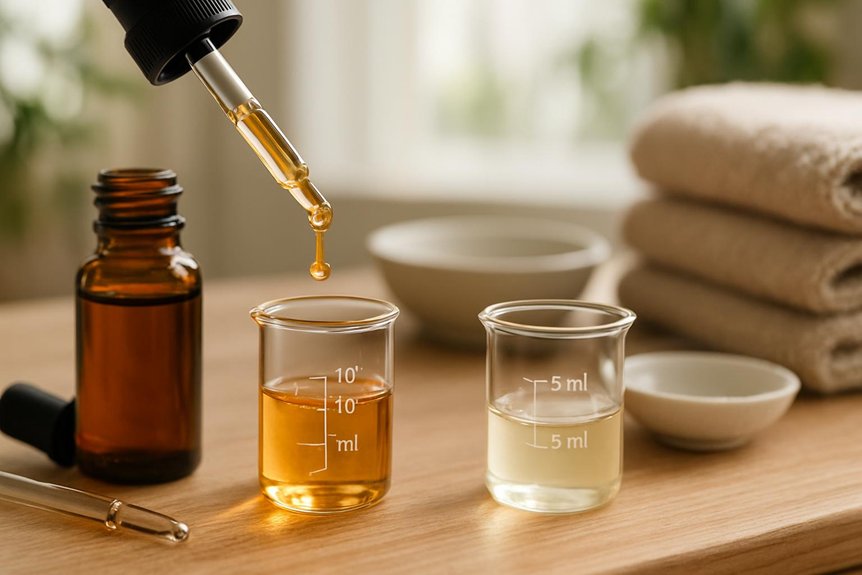
Blends that feel calming or restorative depend as much on correct dilution as on the choice of oils, and frankincense is often misused at home despite being generally well tolerated.
A common error is “neat” application; fix it by keeping face and intimate massage closer to 0.5–1%, and body massage around 1–2% (about 3–6 drops per 10 ml carrier).
Another mistake is guessing volume; measure carrier first, then add drops and mix.
Over-scenting to “make it work” can irritate skin; instead, pair frankincense with gentle oils and keep total essential oil percentage stable.
Skipping a patch test risks surprise redness; test for 24 hours.
In Spa & Massage clinics, therapists avoid irritated or freshly shaved skin.
Store Your Diluted Frankincense Blend Properly
To preserve both skin safety and aroma integrity, a diluted frankincense massage blend should be stored in a clean, airtight dark-glass bottle, kept cool and away from direct light and heat. Oxygen, warmth, and UV exposure accelerate oxidation, which can increase the risk of skin irritation and dull the scent profile. The bottle should be labelled with ingredients, dilution percentage, and the date mixed to support safe, consistent use.
At Spa & Massage clinics across London, therapists recommend making small batches and discarding the blend if its aroma turns sharp, its colour darkens noticeably, or the texture becomes cloudy. Hands and tools should be dry when dispensing to limit microbial contamination of carrier oils. For intimate massage, warming the bottle gently in hands is preferred over microwaving or hot water.
Conclusion
Diluting frankincense for massage is like tuning an instrument: small, measured changes shape the whole experience. Using evidence-based ratios (0.5–3%), a reliable drops-to-mL guide, and a skin-suitable carrier keeps aroma balanced and irritation risk low. Mixing in a clean bottle or bowl, then patch testing for 24 hours, provides a practical safety net. Lower dilutions suit sensitive skin and pregnancy. Proper storage preserves the blend’s steady, calming note.