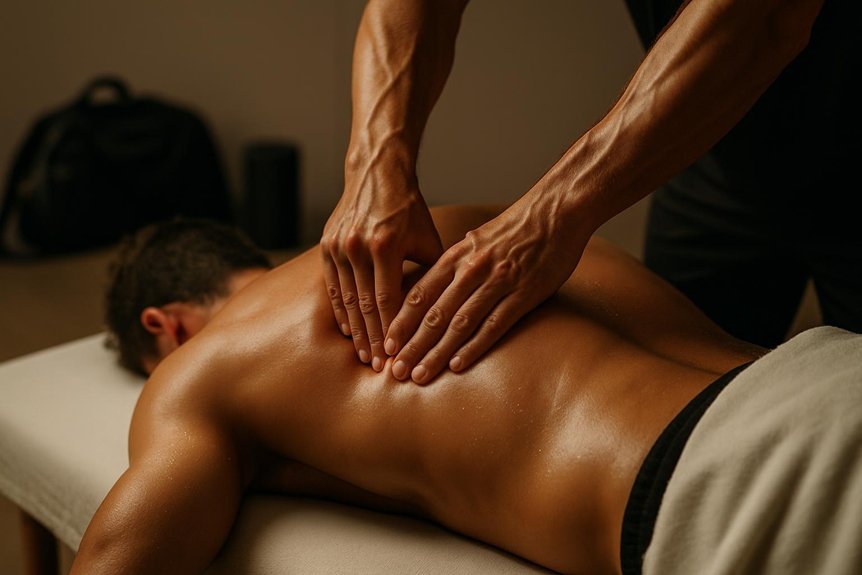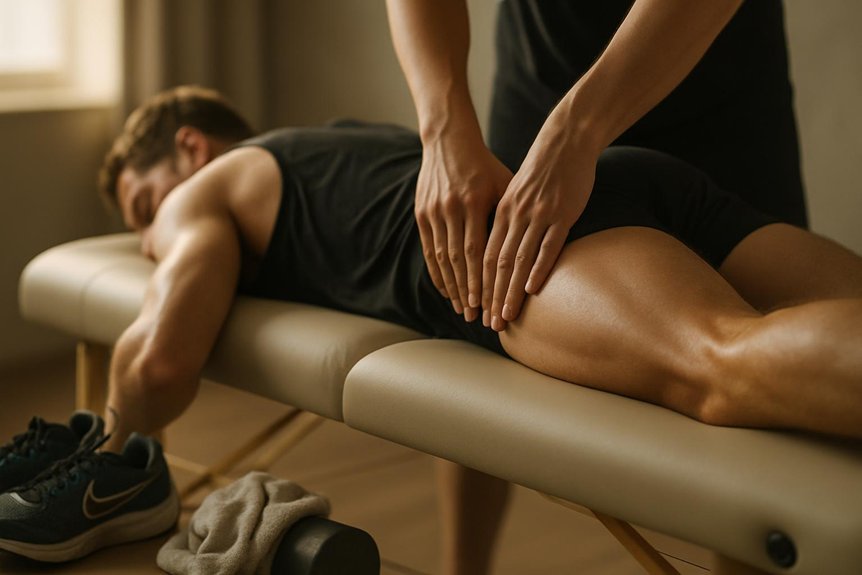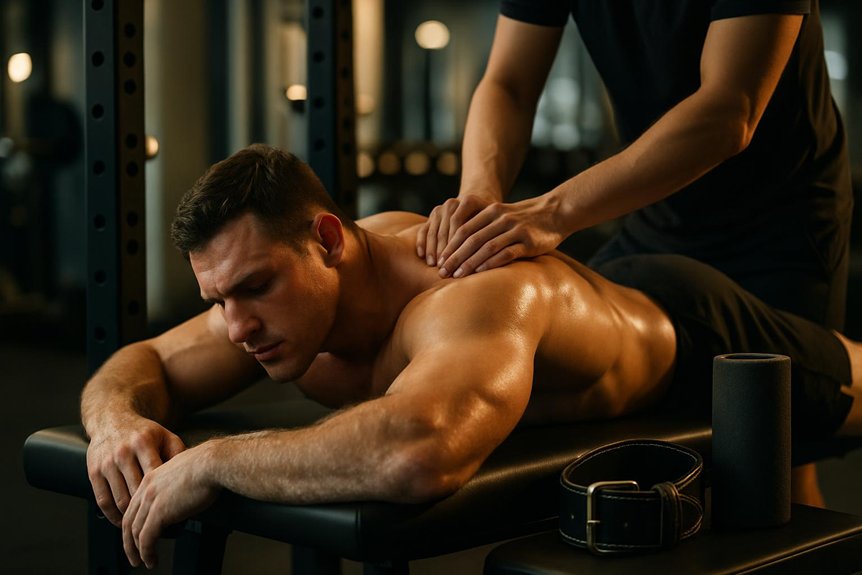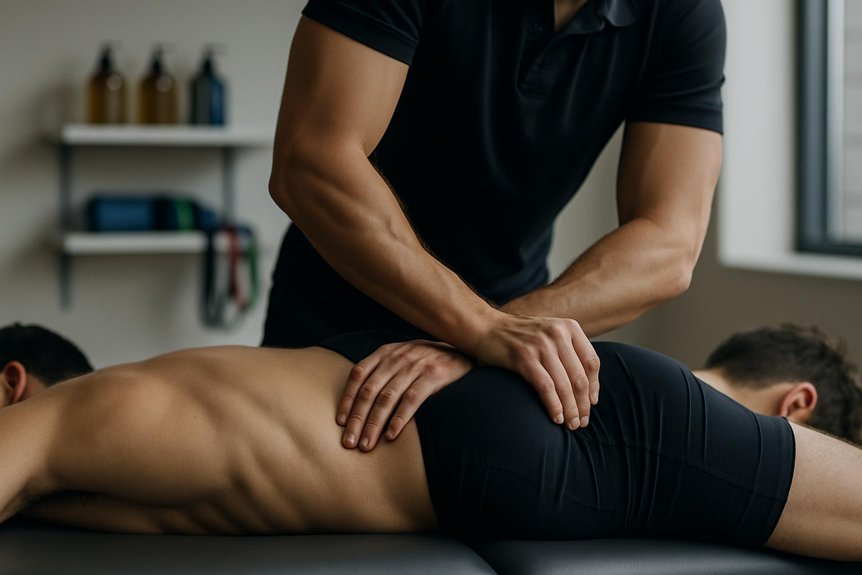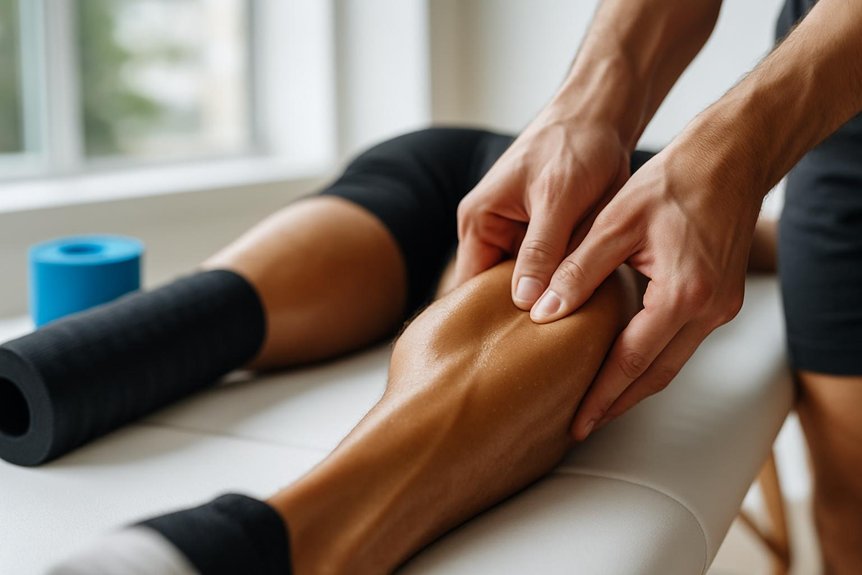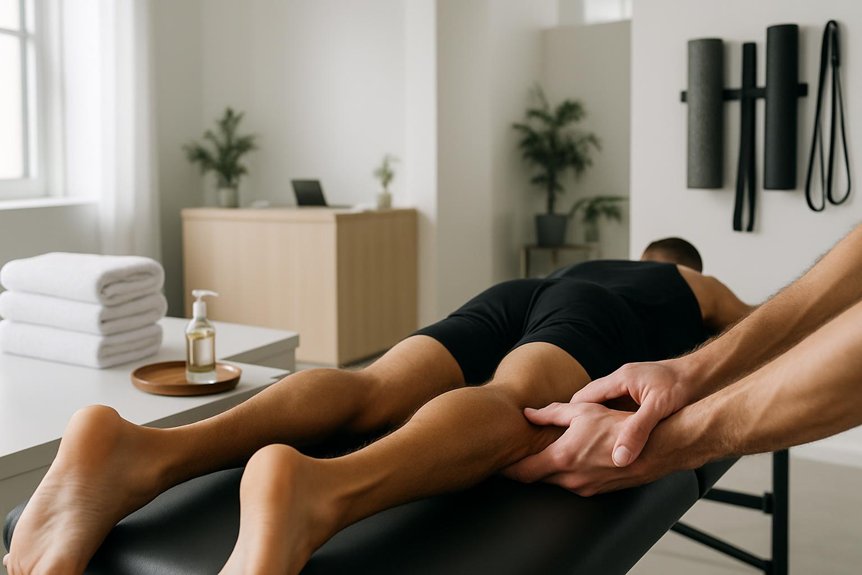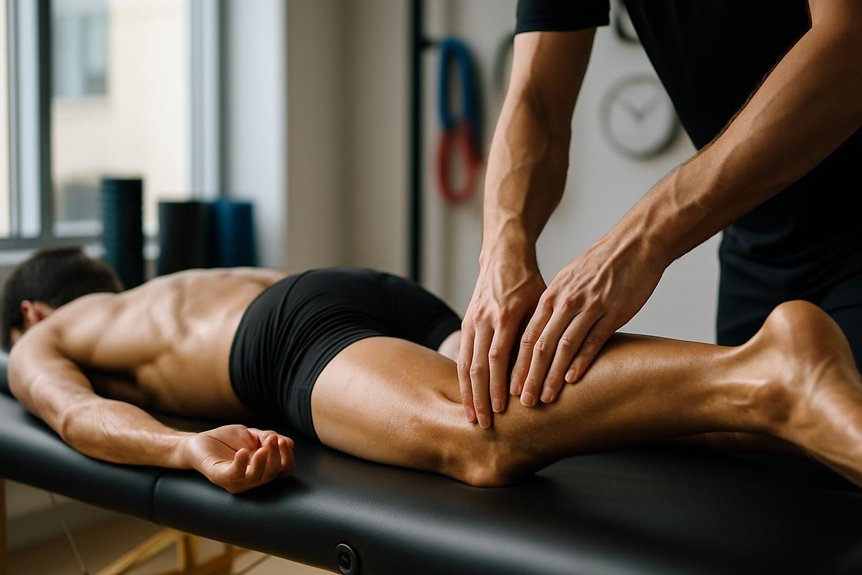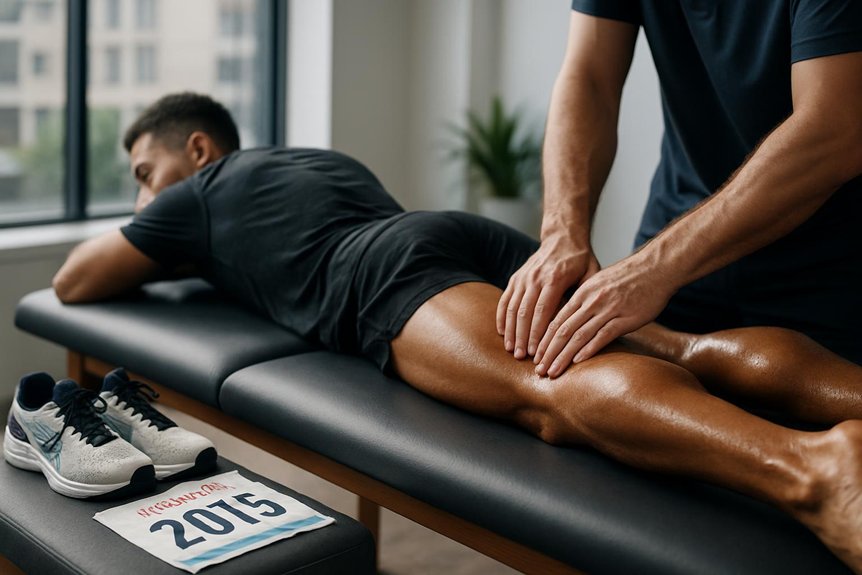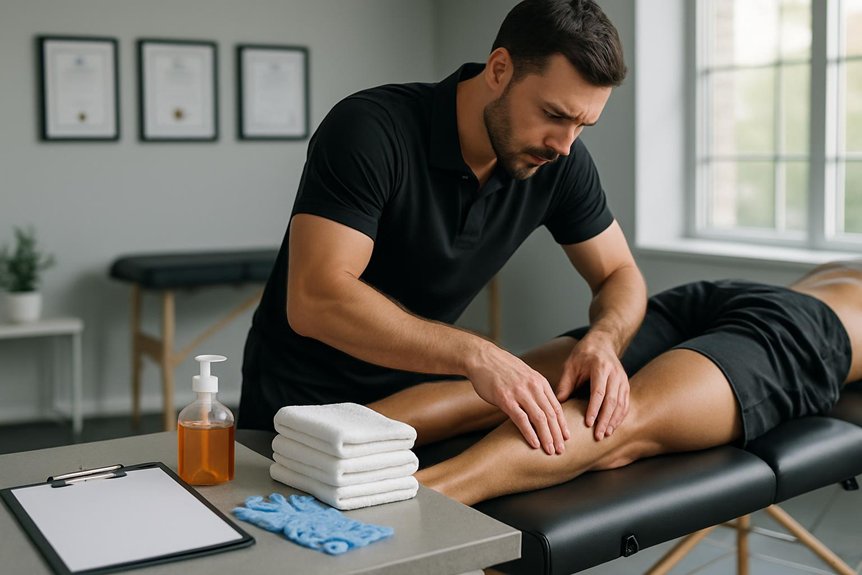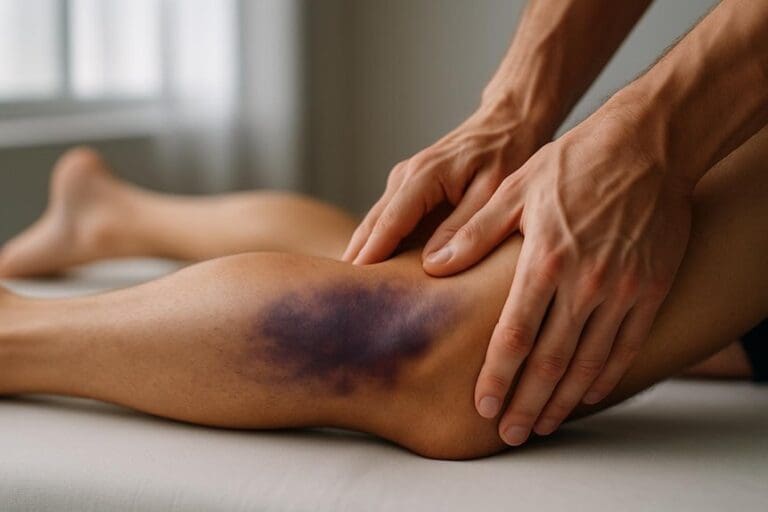
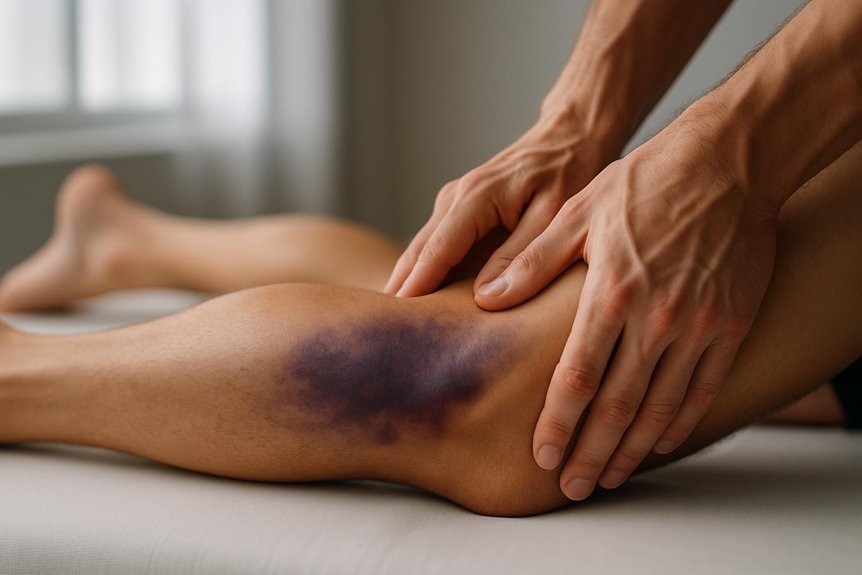
Yes—bruising can occur after performance massage when firm, targeted pressure compresses small capillaries, especially over dense tissue, trigger points, or bony areas. It differs from normal post-massage soreness by showing localised discolouration and surface tenderness, usually appearing within 12–24 hours, darkening over 1–3 days, and fading over 5–14 days. Cooling the area and avoiding heat or further deep pressure helps. Further guidance covers risk factors, timelines, and warning signs.
Can It Cause Bruising?
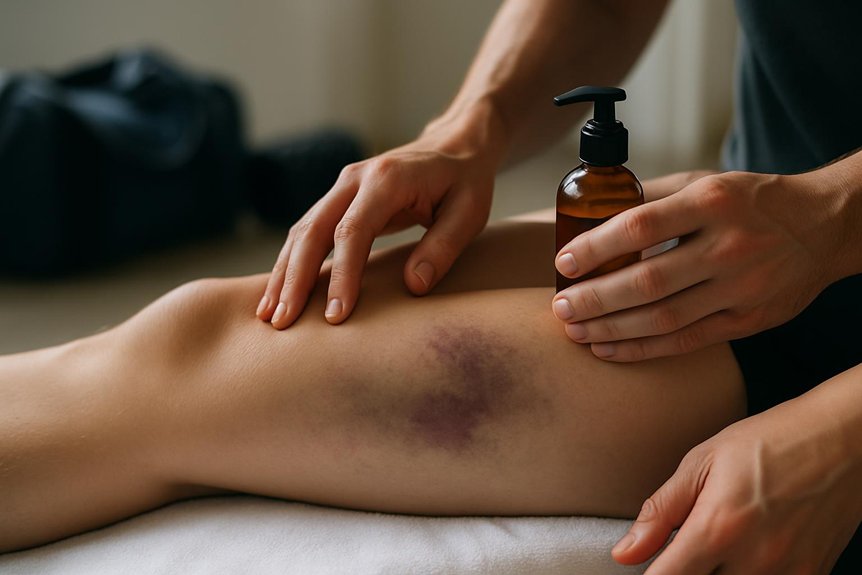
In some cases, performance massage can cause bruising, particularly when firm, targeted pressure is applied to address deep muscle tension or adhesions. This can happen when small surface blood vessels are compressed, leading to mild discolouration that may appear within hours.
At Spa & Massage clinics across London, therapists aim to work effectively while protecting tissue, adjusting depth based on feedback, hydration status, and recent training load. Bruising is more likely with anticoagulant medicines, easy bruising, low body fat over bony areas, or aggressive self-massage between sessions. People seeking close, attentive care are encouraged to share sensitivities, menstrual cycle changes, or prior bruising so pressure can be tailored. If bruising is widespread, unusually painful, or recurrent, medical advice is recommended. It is also used to support athletic recovery and performance, offering benefits for athletes when applied appropriately.
Bruising vs Soreness After Sports Massage: What’s Normal?
After a performance massage, mild, diffuse muscle tenderness is common for 24–48 hours, whereas bruising typically appears as localised discolouration with point tenderness that may develop within hours and evolve over several days.
A typical timeline is that soreness peaks at 24–48 hours and settles by 72 hours, while bruising can darken before fading over 7–14 days depending on intensity and individual factors.
Spa & Massage therapists advise seeking guidance if bruising is extensive or worsening, pain is severe or limits normal movement, or there is unusual swelling, numbness, or symptoms that persist beyond a few days.
Bruising Vs. Normal Soreness
Why do some clients feel tender after a performance massage while others notice visible marks?
Normal soreness is usually diffuse, aching, and felt when moving or pressing the area; it reflects temporary muscle sensitivity after firm, targeted work.
Bruising is different: it appears as localised discolouration (purple, blue, or yellowing) and can feel sharper or more surface‑level, caused by small blood vessels responding to pressure or friction.
In Spa & Massage clinics, therapists aim for therapeutic depth without unnecessary tissue trauma, checking comfort and adjusting pressure, pace, and techniques.
Mild tenderness can be expected, but pronounced, spreading bruises, significant pain, or bruising after light pressure may indicate heightened sensitivity, medication effects, or clotting concerns and warrants clinical advice.
Communication helps tailor intensity safely.
Typical Post-Massage Timeline
Typically, post‑sports‑massage soreness peaks within 24–48 hours and settles over 2–5 days, while any bruising tends to become visible within the first 12–24 hours, darkens over 1–3 days, and then fades gradually over 5–14 days depending on tissue sensitivity and treatment intensity.
During the first day, the area may feel tender and “worked,” especially after deeper techniques. By day two, stiffness can feel more noticeable with movement, then eases as circulation and tissue hydration normalise.
Bruising follows a predictable colour shift (red‑purple to green‑yellow) as the body clears leaked blood products.
At Spa & Massage clinics across London, therapists pace pressure and check in closely, so clients can expect a strong, intimate release without prolonged discomfort.
Gentle walking, hydration, and warmth typically support recovery.
When To Seek Advice
In most cases, post‑massage tenderness and mild, localised bruising are self‑limiting; however, advice should be sought if symptoms are disproportionate or progressive—such as rapidly expanding bruising, severe or worsening pain beyond 48 hours, marked swelling, reduced range of motion, numbness or tingling, unusual warmth/redness, fever, or any bruising that appears without clear treatment intensity.
Extra caution is warranted for clients on anticoagulants, with bleeding disorders, recent injury, or pregnancy.
In these situations, a GP or urgent care should be contacted promptly.
For milder concerns, Spa & Massage recommends checking in with the treating therapist to review pressure, technique, and aftercare, and to adjust future sessions.
A supportive, intimate approach—clear consent, regular feedback, and comfort-focused positioning—helps keep treatment both effective and safe throughout recovery.
Why Performance Massage Sometimes Leaves Bruises
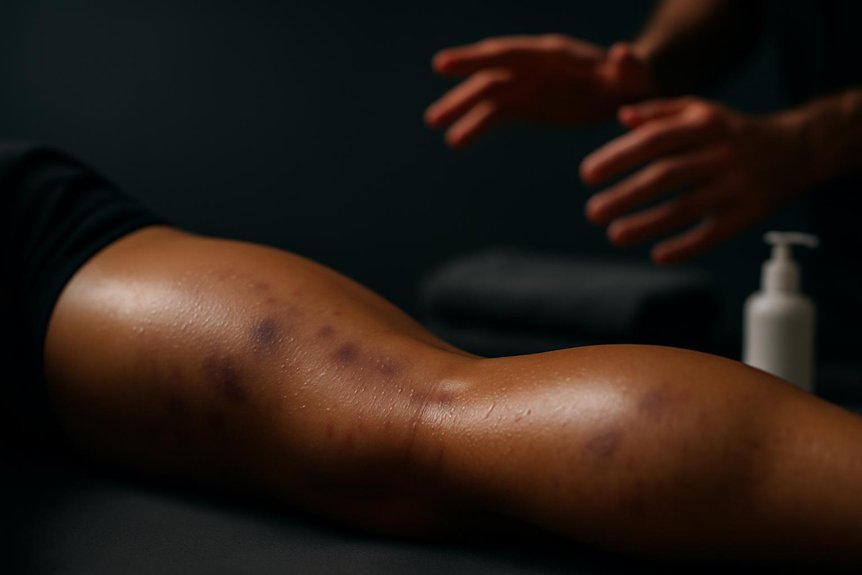
Performance massage can occasionally cause bruising when deep, targeted pressure compresses small capillaries near the skin, allowing minor leakage of blood into surrounding tissue.
This is more likely when a therapist works into dense muscle adhesions or trigger points, where restricted fibres may require focused techniques to restore mobility.
At Spa & Massage clinics, therapists moderate pressure and adjust method in real time to achieve therapeutic effect while minimising unnecessary tissue trauma.
Deep Pressure And Capillaries
Under deep, targeted pressure, a performance massage can sometimes bruise because small surface blood vessels (capillaries) are compressed and may rupture.
This can cause minor bleeding under the skin, appearing as blue-purple marks within 24–48 hours, often with tenderness.
Bruising risk increases with firm techniques, thinner skin, older age, certain medications (for example, anticoagulants), and recent intense training that sensitises tissue.
At Spa & Massage clinics across London, therapists moderate depth, pace, and angle, using clear consent and check-ins so pressure feels intense yet safe and held.
Clients can reduce likelihood by hydrating, arriving warm, and speaking up early.
Seek medical advice if bruising is extensive, worsening, or accompanied by swelling, heat, or unusual pain.
Muscle Adhesions And Trigger Points
Releasing muscle adhesions and trigger points often requires slow, concentrated pressure that can temporarily irritate sensitised tissue and small surface vessels, sometimes resulting in mild bruising. Adhesions are areas where fibres glide less freely; trigger points are irritable nodules that can refer pain.
When these spots are addressed, local blood flow and inflammatory signalling may rise briefly, making the skin more reactive, especially in lean areas. In Spa & Massage clinics, therapists titrate depth, pace, and duration, checking in so the work stays intense yet safe.
Bruising is not required for benefit; it simply indicates superficial vessel stress. Clients are advised to hydrate, apply cool compresses if tender, and avoid heavy training for 24 hours.
Seek medical advice for extensive bruising or severe pain.
What to Do Right Away If You Bruise
If bruising appears soon after a massage, the priority is to minimise further bleeding under the skin and reduce swelling. Apply a cool compress wrapped in a soft cloth for 10–15 minutes, then rest for at least 30 minutes; repeat for the first 24 hours.
Keep the area elevated when practical, and avoid heat, hot baths, alcohol, and vigorous exercise that day. Gentle, pain-free range-of-motion is acceptable, but deep pressure or self-massage should be avoided.
At Spa & Massage, therapists advise light hydration and simple observation: the bruise should not rapidly expand, become markedly hot, or feel intensely painful. Seek medical advice urgently if there is severe swelling, numbness, unusual bruising elsewhere, or anticoagulant use.
Who Is More Likely to Bruise After Performance Massage?
Why do some people develop bruises after a performance massage while others do not? Risk varies with tissue fragility and clotting factors. People taking anticoagulants, antiplatelets, NSAIDs, or high-dose fish oil bruise more easily. Those with anaemia, low vitamin C, liver disease, or bleeding disorders also have increased susceptibility. Ageing skin, fair or thin skin, and connective-tissue laxity can make capillaries more vulnerable.
Recent intense training, dehydration, inadequate sleep, or previous bruising may amplify tenderness and microtrauma. At Spa & Massage, therapists screen health history and adjust pressure, pacing, and techniques, offering close, consent-led communication so clients can feel safely held. Anyone with unexplained frequent bruising should seek medical advice before deep work.
Where Performance Massage Bruises Usually Appear
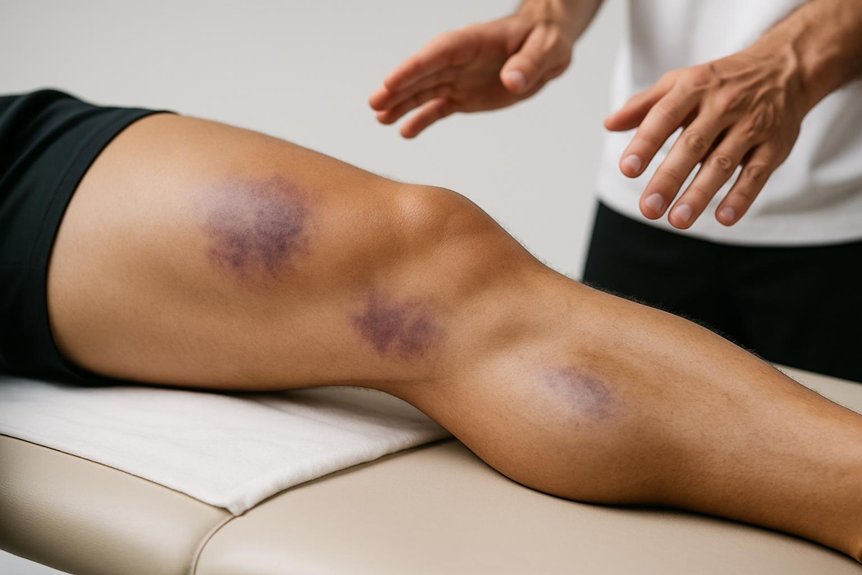
Depending on the techniques used and the client’s tissue sensitivity, performance massage bruises most often appear over large, superficial muscle groups where firm pressure or sustained friction is applied.
Typical sites include the quadriceps and hamstrings, calves, gluteal region, and upper back (trapezius/rhomboids), especially after deep stripping or compression.
Bruising can also show along the iliotibial band area, where tissues are dense and close to the skin.
Around the shoulders and upper arms, small marks may occur where trigger points are worked.
Less commonly, light bruising may appear near bony landmarks—such as the shin, hip crest, or shoulder blade—if pressure is not well buffered.
At Spa & Massage, therapists adjust depth, pace, and contact to protect comfort and privacy.
How Long Bruising After Performance Massage Lasts
Over the first 24–72 hours after a performance massage, any mild bruising typically becomes most visible and then begins to fade, with most marks resolving within 3–10 days.
Colour often shifts from purple-blue to green-yellow as the body reabsorbs pooled blood.
Duration varies with pressure used, local tissue sensitivity, vascular fragility, hydration status, and whether treatment targeted tight, overworked areas such as calves, glutes, or shoulders.
In Spa & Massage clinics, therapists modulate depth and check in closely, which helps keep post-treatment marking mild and short-lived.
Gentle warmth, light movement, and avoiding heavy training on the treated area for 24–48 hours can support comfortable recovery. If desired, arnica gel may be used on intact skin.
Generally, tenderness decreases as discolouration fades.
When Bruising After Performance Massage Is a Red Flag
Most post-sports-massage bruising fades steadily within a week or so, but certain patterns warrant caution.
Bruising that expands rapidly, becomes very painful, feels hot, or is accompanied by marked swelling may suggest a haematoma or inflammation requiring medical review.
Red flags also include numbness, tingling, weakness, reduced range of motion, or pain that worsens after 48 hours.
Any bruise with fever, dizziness, shortness of breath, or chest pain warrants urgent assessment.
People taking anticoagulants, steroids, or with bleeding disorders should seek advice if bruising is extensive or appears in multiple areas.
At Spa & Massage clinics across London, therapists advise clients to contact their GP or NHS 111 when symptoms feel “not right,” and to pause further deep work until cleared.
How to Prevent Bruising at Your Next Performance Massage
With the right screening, pressure choice, and aftercare, bruising after a performance massage can often be minimised. At Spa & Massage, therapists ask about anticoagulants, recent injury, easy bruising, and training load, then adapt technique accordingly. Clients should request “firm but comfortable” pressure, avoid pain-chasing, and agree a stop signal; slow, sustained strokes reduce capillary shear versus aggressive friction. Hydration and a light meal beforehand can support tolerance.
After treatment, gentle movement, warmth, and adequate sleep may aid recovery; heavy lifting or high-impact sessions are best delayed for 24 hours. If tenderness appears, a cool compress for 10 minutes can help. Any rapidly spreading, severe, or unexplained bruising warrants medical review.
Conclusion
Bruising after performance massage can be a benign footprint of deep work, like a faint shadow where tight tissue finally yielded. In most cases it is mild, localised, and fades as circulation and healing settle over the area. Early cold compresses, hydration, and lighter activity can reduce discomfort. However, persistent, expanding, or unexplained bruising warrants medical review, especially with bleeding risks. With clear communication and appropriate pressure, massage remains a safe, restorative tool.